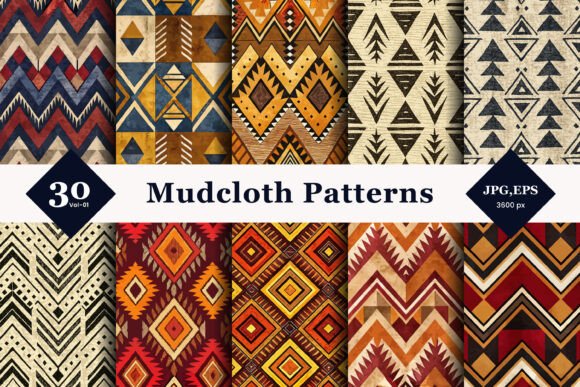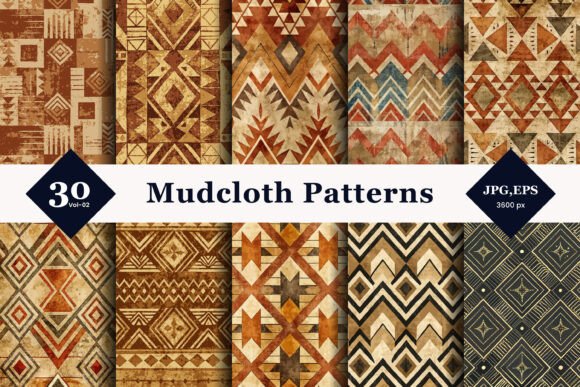
Evaluating Mudcloth Style Seamless Patterns 02: A Deep Dive into Traditional African Design Assets
In the realm of graphic design and textile arts, few visual languages carry as much weight and historical resonance as traditional African motifs. For professionals seeking to incorporate authentic cultural aesthetics into their work, the Mudcloth Style Seamless Patterns 02 collection presents a compelling option. This resource is not merely a set of decorative images; it is a curated library of 30 unique patterns that bridge the gap between ancient craftsmanship and modern digital utility. By understanding the specific attributes of this collection, designers can make more informed decisions about when and how to integrate these assets into their projects.
The core appeal of Mudcloth Style Seamless Patterns 02 lies in its dual format availability. Each pattern is provided in both high-resolution JPG files at 300 DPI and editable EPS vector files. This combination addresses two critical needs in professional workflows: immediate visual impact for print and web, and scalability for large-format applications without loss of quality. The collection is designed for those who value the "spirit" of traditional design, offering a blend of beauty and meaning that goes beyond superficial ornamentation.
Understanding the Aesthetic and Technical Specifications
Mudcloth, or bògòlanfini, originates from the Bamana people of Mali. Traditionally, these textiles are hand-woven cotton cloth dyed with fermented mud leaves, resulting in distinct geometric symbols that often convey proverbs, social status, or historical events. The Mudcloth Style Seamless Patterns 02 collection captures this essence digitally. It does not simply replicate a single artifact but rather interprets the stylistic vocabulary of the medium—bold contrasts, intricate geometric repetition, and earthy color palettes.
From a technical standpoint, the inclusion of EPS vector files is a significant differentiator. In the past, many texture packs offered only raster images, limiting their use to fixed dimensions. With vector formats, designers can scale these patterns infinitely. Whether you are creating a business card or wrapping an entire building facade, the lines remain crisp. The 300 DPI JPGs ensure that the textures hold up under close inspection in high-quality print runs, such as packaging, editorial layouts, or fine art reproductions.
- Format Versatility: The simultaneous provision of raster and vector files eliminates the need for separate purchases or manual tracing, saving time in the production pipeline.
- Seamless Tiling: As the name suggests, these patterns are engineered to tile seamlessly. This is crucial for background designs, fabric printing, and surface pattern development where continuity is key.
- Cultural Depth: Unlike generic geometric packs, these designs are rooted in a specific aesthetic tradition, adding a layer of narrative depth to projects that require cultural sensitivity and authenticity.
Comparing Mudcloth Style Patterns 02 Against Other Asset Types
When evaluating design resources, it is helpful to compare specialized collections like Mudcloth Style Patterns 02 against broader alternatives. For instance, generalist texture packs often include hundreds of low-specificity images, such as abstract gradients or generic wood grains. While cost-effective, these lack the distinct character required for branding or thematic projects. Mudcloth Style Patterns 02 trades volume for specificity. You get fewer assets (30 patterns) but each one is highly detailed and thematically consistent.
Another common alternative is purchasing individual stock photos of physical mudcloth textiles. While a photograph offers realism, it suffers from lighting inconsistencies, wrinkles, and perspective distortion. Digitally created seamless patterns offer a clean, uniform canvas that is easier to manipulate in software like Adobe Illustrator or Photoshop. Furthermore, the vector nature of the EPS files allows for color manipulation. A designer can shift the palette from traditional earth tones to vibrant, contemporary hues while maintaining the structural integrity of the design—a flexibility not possible with static photographic references.
However, there are tradeoffs. If a project requires hyper-realistic texture mapping, such as simulating the rough weave of actual cloth for a 3D render, these flat digital patterns may feel too clean. In such cases, combining the Mudcloth patterns with noise filters or displacement maps might be necessary to achieve tactile realism. Understanding this limitation helps in setting realistic expectations for the asset's application.
Ideal Use Cases and Target Audiences
The versatility of Mudcloth Style Seamless Patterns 02 makes it suitable for a diverse range of professionals. Graphic designers will find immediate utility in using these patterns for brand identity systems, particularly for companies in the lifestyle, travel, or ethical fashion sectors. The patterns can serve as subtle background elements that reinforce a brand’s connection to heritage and sustainability without overwhelming the primary message.
Home stylists and interior designers can leverage these patterns for mood boards and conceptual presentations. The high resolution ensures that clients can visualize how a mudcloth-inspired wallpaper or upholstery fabric might look in a space. Because the patterns are seamless, they can be easily previewed as full-wall coverings, allowing for accurate assessment of scale and density.
Crafters and small business owners also benefit from the instant download aspect. For those producing limited-run merchandise, such as tote bags, notebooks, or greeting cards, having ready-to-print 300 DPI files reduces turnaround time. The ability to resize vectors ensures that logos or text can be overlaid on the patterns without pixelation, streamlining the prototyping process.
Evaluating Limitations and Decision Factors
While the collection is robust, it is important to consider when it might not be the right choice. The aesthetic is bold and culturally specific. Projects requiring minimalist, neutral, or corporate-clean visuals may find these patterns too visually dense. Additionally, because the designs are inspired by traditional African art, users must approach them with cultural respect. Misappropriation is a significant concern in the design industry; therefore, it is advisable to understand the symbolism behind the motifs if they are used in contexts where meaning matters, such as marketing materials targeting specific communities.
Furthermore, the price point should be evaluated against the volume of assets. For a beginner designer needing a vast library for experimentation, a subscription-based service offering thousands of generic assets might seem more economical. However, for a professional seeking a cohesive, high-quality set that requires minimal editing, the targeted nature of Mudcloth Style Patterns 02 offers better value per usable asset. The instant download feature also mitigates the risk of waiting for shipping, which is a practical advantage for tight deadlines.
Strategic Integration into Your Workflow
To maximize the utility of these 30 patterns, consider integrating them early in the ideation phase rather than as an afterthought. Start by experimenting with the EPS files in vector software to test different color combinations. This approach allows you to customize the patterns to match specific brand guidelines before exporting them as high-res JPEGs for final layout. This workflow leverages the strengths of both formats, ensuring that the final output is both scalable and print-ready.
For web designers, remember that while 300 DPI is ideal for print, web assets should be optimized for file size. Use the vector source to create smaller, compressed versions for screen display, ensuring fast load times without sacrificing visual clarity. The seamless nature of the patterns allows them to be used as CSS backgrounds or SVG elements, providing a lightweight yet sophisticated touch to digital interfaces.
In conclusion, Mudcloth Style Seamless Patterns 02 stands out as a specialized tool for designers who prioritize cultural authenticity and technical flexibility. Its strength lies in the careful balance between traditional aesthetic values and modern digital convenience. By understanding its capabilities, limitations, and ideal applications, professionals can effectively harness these 30 unique patterns to create work that is not only visually striking but also meaningful and technically sound. Whether you are designing for print, web, or craft, this collection offers a reliable foundation for incorporating the rich spirit of African design into your creative practice.