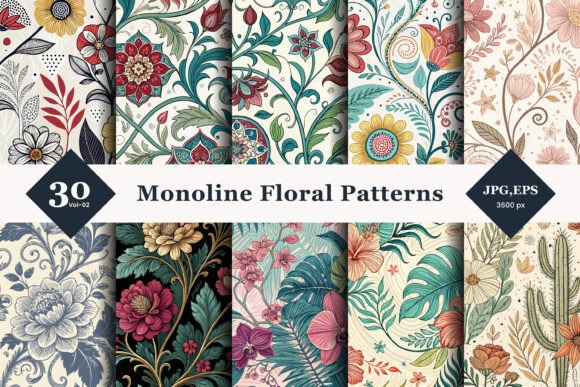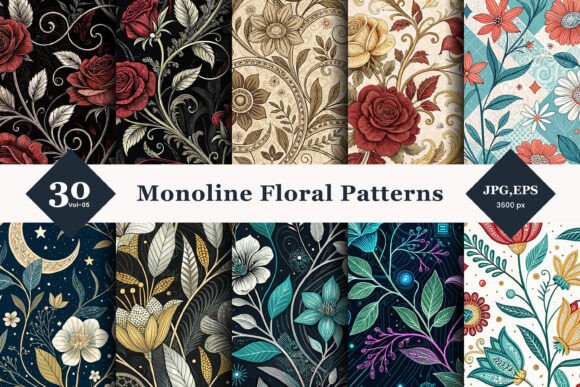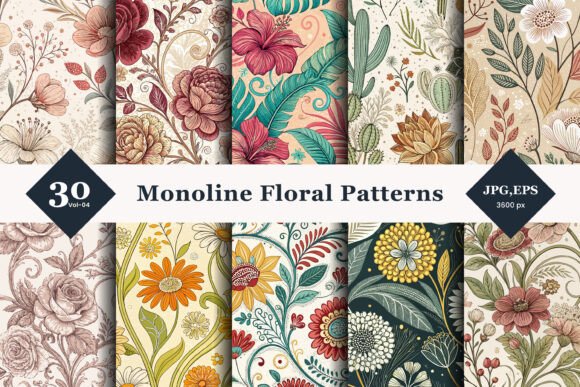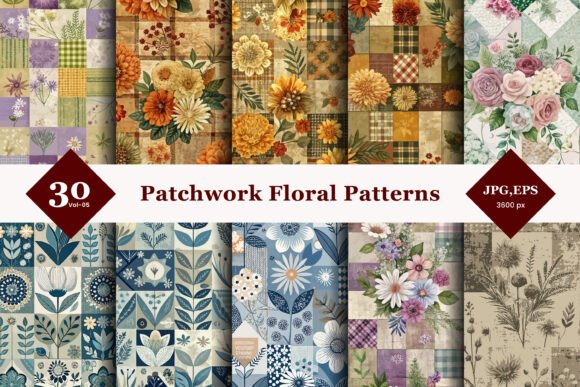
Monoline Floral Seamless Patterns 06: A Practical Review for Modern Designers
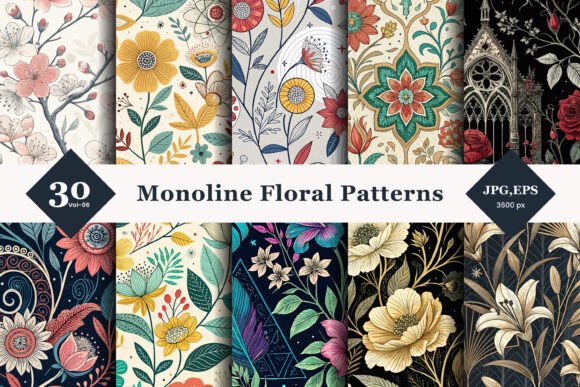
In the current landscape of digital and print design, the demand for assets that balance aesthetic appeal with technical versatility is higher than ever. Among the various trend cycles that influence visual communication, minimalist line art has established a durable presence, offering a clean alternative to the heavy textures and complex gradients that dominated previous eras. Monoline Floral Seamless Patterns 06 represents a curated collection designed to meet this specific need, providing thirty intricate floral motifs crafted with elegant simplicity. For professionals ranging from web developers to packaging designers, understanding the practical utility of such a resource requires looking beyond surface-level aesthetics to evaluate file integrity, scalability, and integration potential.
The Core Concept: Elegance Through Simplicity
The defining characteristic of this collection is its adherence to monoline styling. This technique involves using lines of uniform or near-uniform thickness to create form, stripping away the noise of shading and color blocking. The result is a pattern set that feels sophisticated without being overwhelming. In an era where user interface (UI) elements often compete for attention on small screens, or where product packaging must stand out in a crowded retail environment, this level of restraint is a significant advantage.
Monoline Floral Seamless Patterns 06 does not attempt to replicate botanical realism. Instead, it abstracts natural forms into geometric and organic lines that suggest the structure of flowers, leaves, and vines. This abstraction allows the patterns to serve as background textures or subtle accents rather than dominant focal points. For a brand identity seeking to convey modernity, clarity, and organic growth, these designs offer a visual language that aligns with those values. The "seamless" nature of the patterns is critical; it ensures that when tiled, the transition between edges is invisible, creating an infinite canvas that can be scaled to any dimension without visible breaks or awkward overlaps.
Technical Specifications and File Integrity
For any creative professional, the usability of an asset is determined as much by its technical delivery as by its visual appearance. This collection addresses common pain points in asset acquisition by providing files in both EPS and JPG formats, catering to different stages of the workflow.
- EPS Vector Files: The inclusion of Encapsulated PostScript (EPS) files is perhaps the most valuable feature for long-term project viability. Vectors are resolution-independent, meaning they can be resized from a tiny favicon to a large-scale billboard without any loss of quality. For designers working in Adobe Illustrator, Affinity Designer, or similar vector-based software, these files allow for further customization. Users can alter stroke weights, change colors to match specific brand palettes, or isolate individual motifs within the larger pattern. This flexibility transforms the asset from a static image into a modular design component.
- High-Resolution JPGs: The 300 DPI JPEG files provide immediate utility for raster-based workflows. These are ideal for quick mockups, social media graphics, or direct insertion into Photoshop projects where vector editing is unnecessary. At 300 DPI, the images are suitable for high-quality offset printing, ensuring that fine details in the monoline work remain crisp on paper. However, unlike the EPS versions, these cannot be infinitely scaled, making them best suited for fixed-dimension outputs.
The availability of both formats mitigates the risk of compatibility issues. A designer might start a project in a vector program for precision but later need to export a raster version for web optimization. Having both formats readily available streamlines this process, reducing the time spent on conversion and rendering.
Practical Applications Across Industries
The versatility of Monoline Floral Seamless Patterns 06 makes it relevant across a broad spectrum of industries. Its minimalist nature means it can adapt to various brand voices, from corporate and tech-forward to artisanal and lifestyle-oriented.
Web and Digital Interface Design
In web design, background patterns are often used to add depth to landing pages, about sections, or blog layouts without distracting from the primary content. Because monoline patterns have low visual weight, they do not compete with typography or call-to-action buttons. They provide a subtle texture that enhances readability and engagement. Furthermore, because the EPS files are scalable, designers can use SVG conversions of these vectors for responsive web design, ensuring fast load times and sharp rendering on retina displays.
Product Packaging and Print Materials
For small business owners and entrepreneurs, packaging is a crucial touchpoint. Whether designing labels for candles, cosmetics, food products, or luxury goods, the choice of pattern can elevate perceived value. The intricate yet simple nature of these floral motifs suggests craftsmanship and attention to detail. When printed on textured papers or specialty stocks, the thin lines of the monoline style can create a delicate, premium feel. The seamless capability allows for wrapping around boxes or bottles continuously, eliminating the need for complex alignment during the printing process.
Crafting and Physical Goods
Beyond digital and commercial print, these patterns are highly effective for physical crafting projects. Artists using laser cutters, vinyl cutters, or plotter machines benefit significantly from the vector format. The clean lines translate directly to cutting paths, allowing for precise reproduction in materials like wood, acrylic, or cardstock. Hobbyists and makers can use these designs to create decorative wall art, stencils, or textile prints. The instant download aspect ensures that creators can move from concept to production quickly, which is essential for meeting tight deadlines or capitalizing on trending topics.
Evaluating Strengths and Potential Limitations
When assessing whether Monoline Floral Seamless Patterns 06 fits a specific workflow, it is important to weigh its strengths against potential limitations. The primary strength lies in its consistency and cohesion. All thirty patterns share a unified visual language, which means a designer can mix and match motifs from the set without creating visual dissonance. This coherence is difficult to achieve when sourcing assets from multiple disparate libraries.
However, the very simplicity that defines this collection may also be a limitation for certain use cases. If a project requires bold, graphic statements, heavy textures, or vibrant, saturated color fields, these patterns may appear too subtle. They are best utilized as supporting elements rather than main subjects. Additionally, while the monoline style is timeless, it is also widely used. Designers should consider how they integrate these patterns to ensure their final output does not feel generic. Customization—such as altering colors, adjusting opacity, or combining with other graphic elements—is essential to giving these standard patterns a unique identity.
Who Benefits Most?
This resource is particularly well-suited for freelancers and agencies who need reliable, high-quality assets to speed up their production pipeline. It is equally valuable for educators teaching design principles, as the clean lines make it easy to analyze composition and negative space. Small business owners who lack dedicated design teams can also leverage these patterns to maintain a professional look across their marketing materials without incurring high costs for custom illustration.
For serious hobbyists and bloggers, the ease of use provided by the JPG files allows for immediate application in online content, while the vector files offer room for growth as their skills develop. The instant download feature removes friction from the creative process, allowing users to experiment freely and iterate quickly.
Final Considerations on Value and Usability
The true value of Monoline Floral Seamless Patterns 06 extends beyond the thirty included designs. It offers a toolkit for efficiency. In a market where time is a scarce resource, having access to professionally crafted, technically sound assets allows creators to focus more on strategy and less on execution. The combination of vector and raster formats ensures that the investment remains useful regardless of future software updates or shifting project requirements.
Ultimately, this collection succeeds by respecting the intelligence of the user. It provides high-quality building blocks without dictating exactly how they must be used. By embracing the constraints of monoline design, it achieves a level of sophistication that resonates with contemporary audiences. For anyone looking to infuse their projects with a touch of natural elegance and modern clarity, this pattern set offers a robust, flexible, and aesthetically pleasing foundation. It is a practical addition to any digital asset library, capable of enhancing everything from a simple blog post header to a complex brand identity system.